| Seeds of Change | |||
| “Seeds of Change” is a hand-embroidered artwork by Sarah (Juby Aleyas Koll), jointly conceptualised with climate scientist Roxy Mathew Koll. It was presented to Mary Robinson, former President of Ireland, by Women Moving Millions as part of their 2025 Catalyst Award—honoring her lifelong work in climate justice and her leadership in the global initiative Project Dandelion.
The central figure portrays a woman as the face of climate justice—those most burdened by a warming planet yet leading its renewal and resilience. Her flowing hair is embroidered with the Warming Stripes, using temperature data from 1850 to 2024, illustrating how the world has warmed over time and the weight women carry in this global struggle.
The strands of her hair transform into the ocean, flora, and fauna, expressing the movement from ego to eco. The artwork celebrates women’s resilience and Mary Robinson’s role as a catalyst for change in a changing climate.
From her hand, a dandelion releases its seeds, inspired by Mary Robinson’s Project Dandelion, symbolising hope and collective action spreading across borders.
| |||
| The Ocean of Small Things | |||
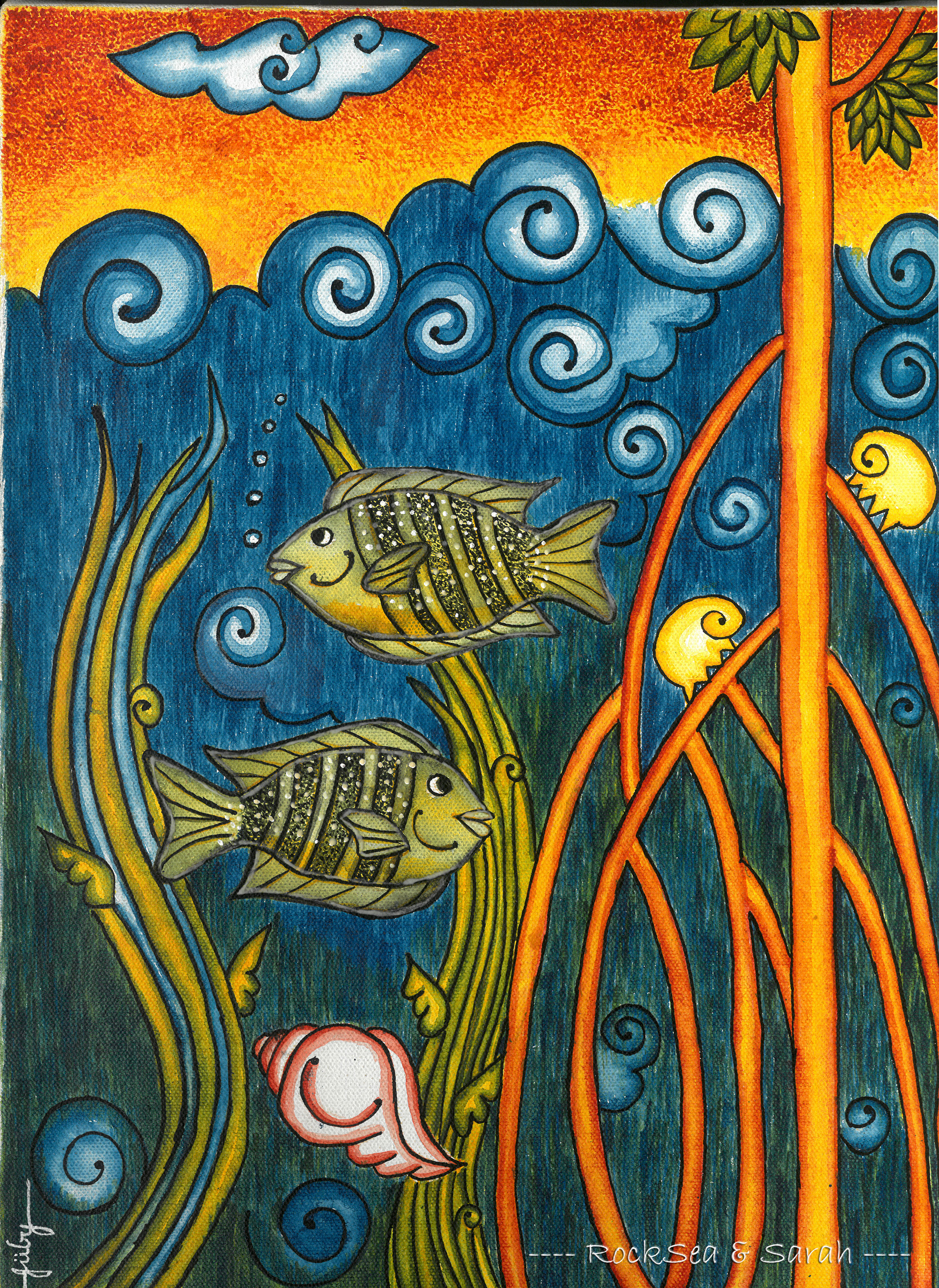
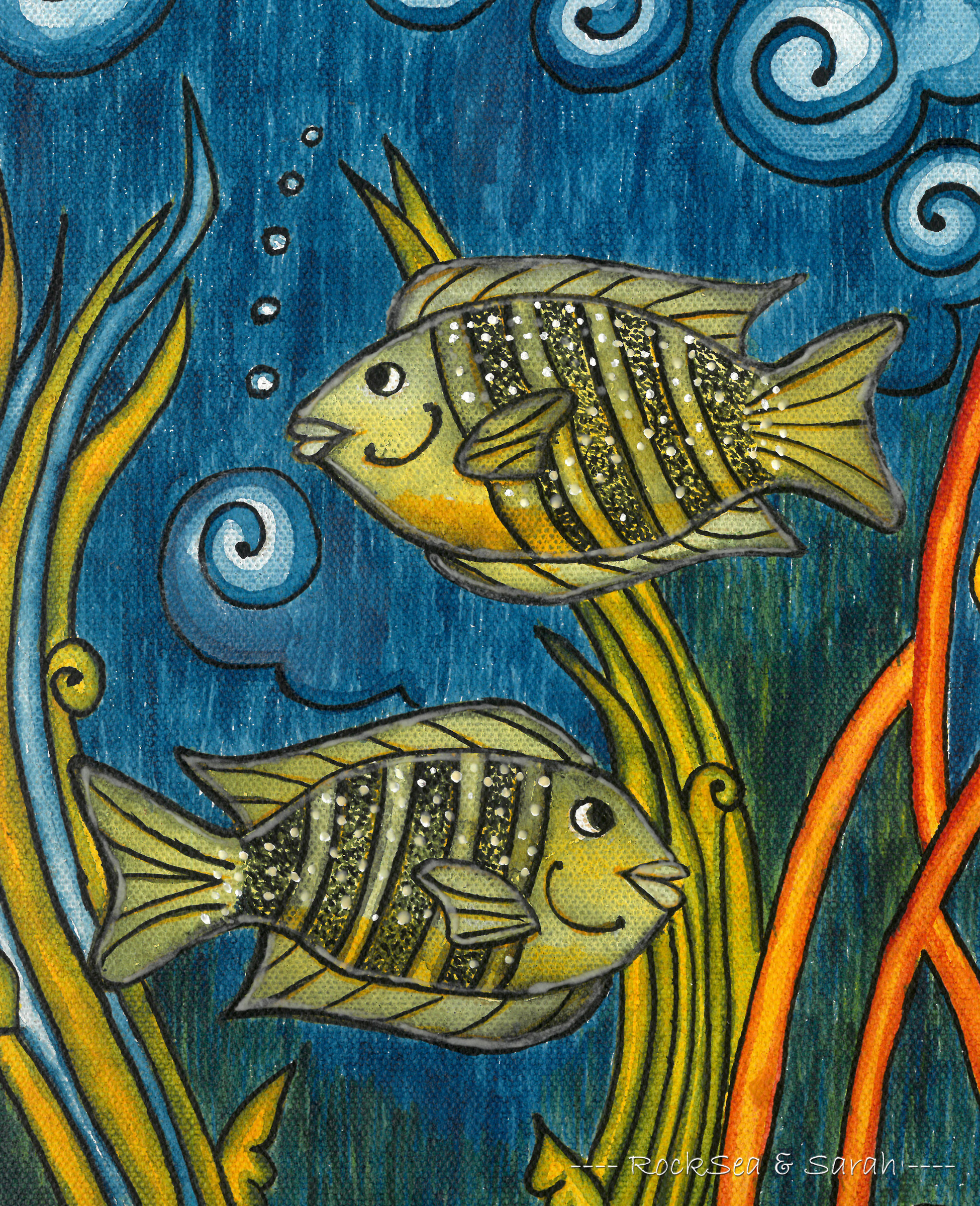
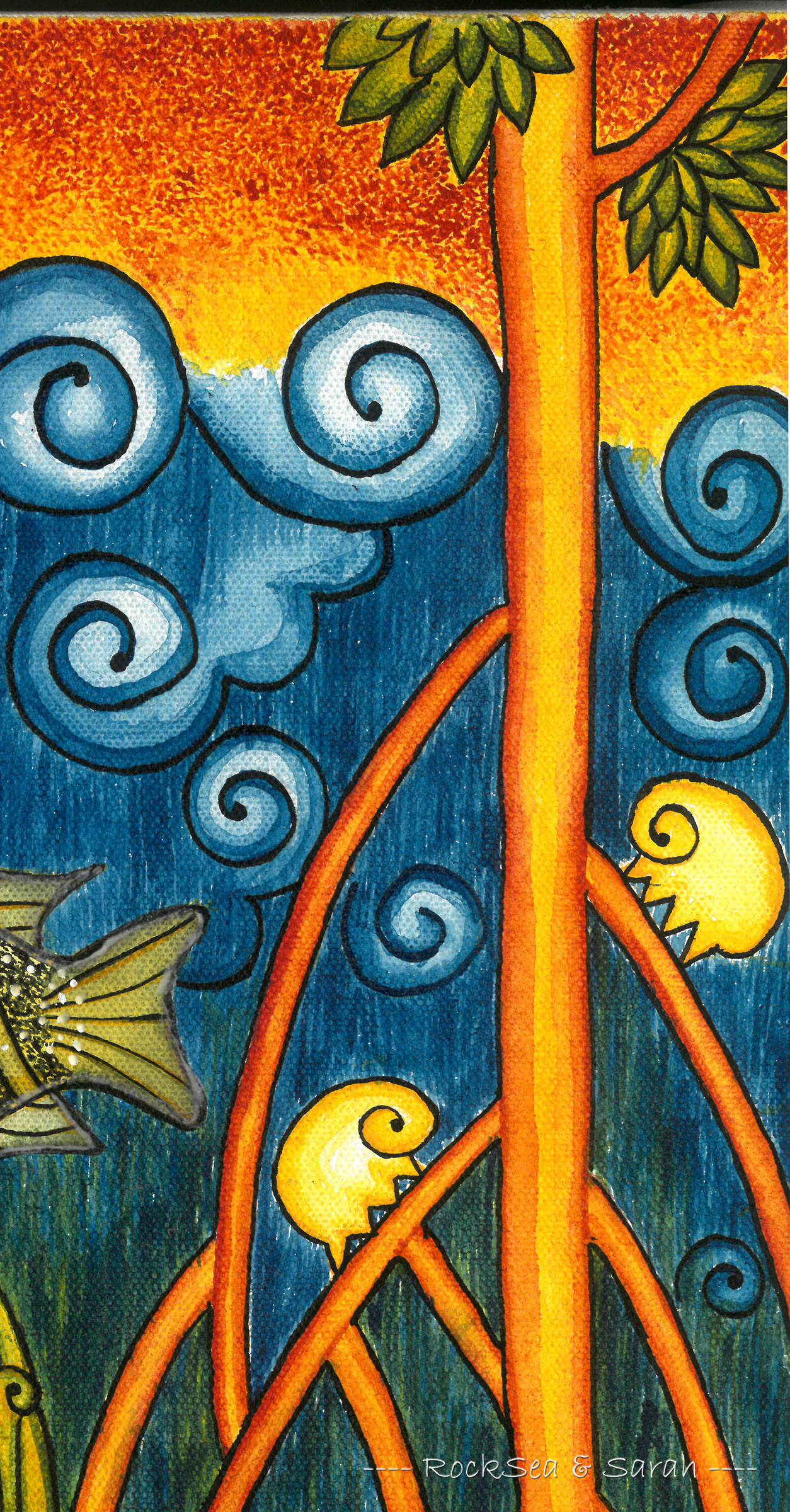
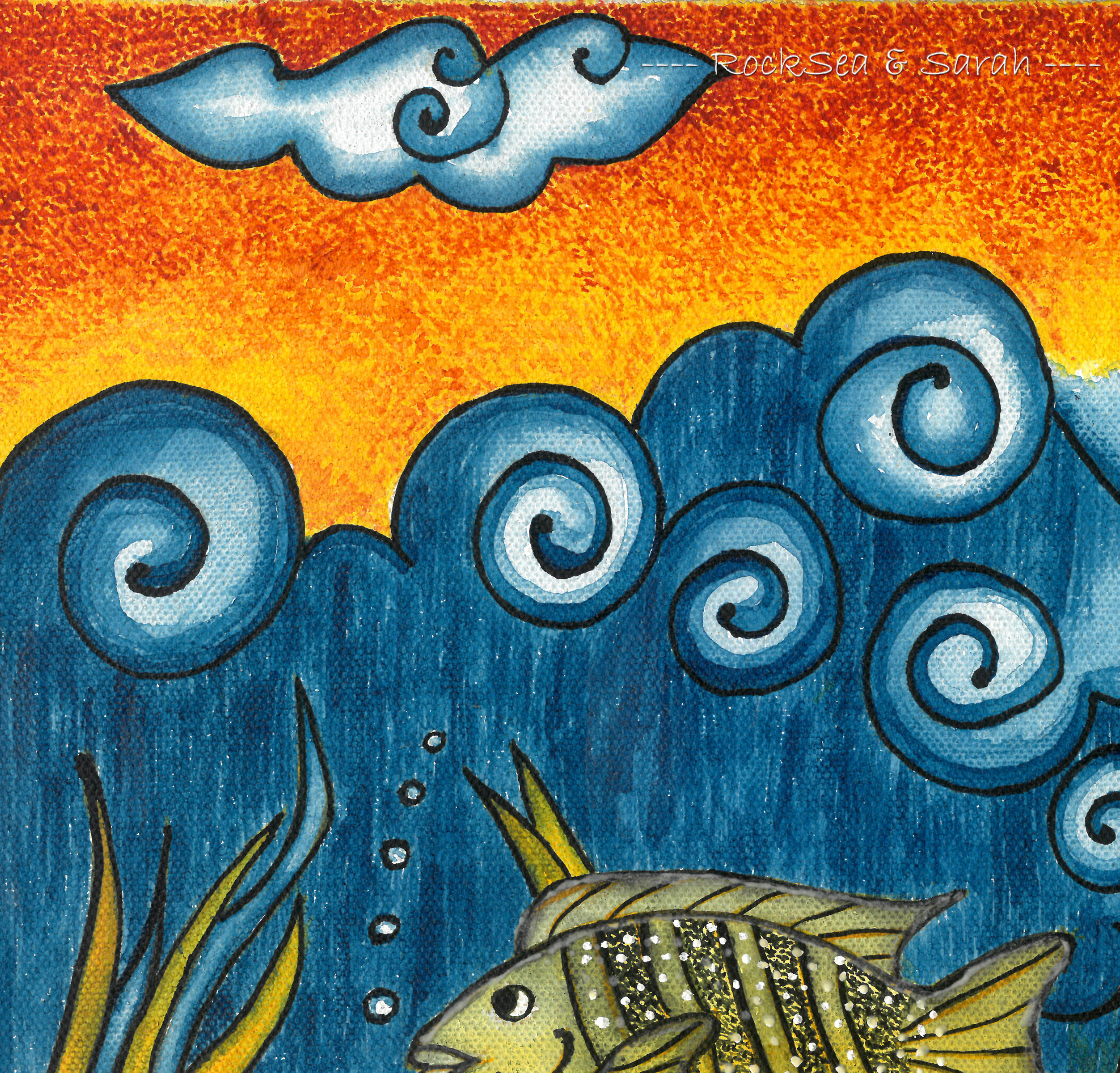
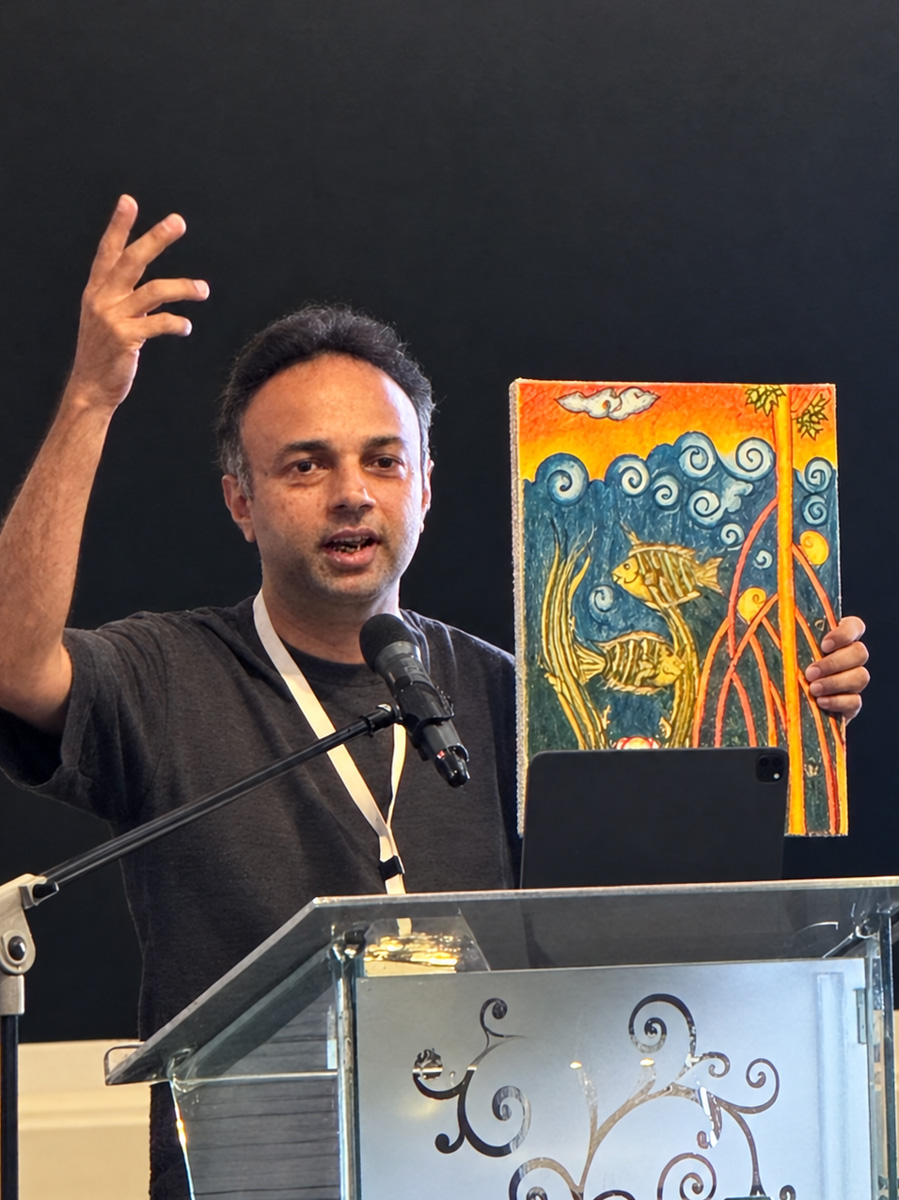
| “The Ocean of Small Things”, is an artwork created by Juby Aleyas Koll (Sarah), with scientific ideas and insights from Roxy Mathew Koll. Two fish, mangrove roots, waves, and a cloud. These familiar elements bring together the history and living connections of the Indian Ocean, from moving continents to the oxygen that allows a fish to breathe.
A Tale of Two Fishes. The pearl spot, or karimeen, in Kerala’s backwaters has cousins in Madagascar. The two fish in this artwork bring these relatives together, across the ocean that separates their shores. Their family resemblance takes us back into the geological and evolutionary history of the Indian Ocean. India and Madagascar were once together, before separating about 90 million years ago.
Mangrove roots provide shelter, feeding areas and places for reproduction. The tree reaches from the land into the water, where its roots become part of the habitat of fish and other organisms. The plants, shell and smaller creatures belong to this shared system. Coastal backwaters are integral to the Indian Ocean and its relationship with the lands around it.
The ocean and atmosphere interact. These interactions carries on to the land. Look at the blue wavy clouds and the blue curly waves. They both carry water, and they both are in motion. Water moves through the sea and sky, connecting them through evaporation, clouds and rainfall.
The bubbles. Fish extract dissolved oxygen through their gills. Oxygen enters the water from the atmosphere and through photosynthesis by aquatic plants and algae. Winds and waves help it mix into the water. Temperature and salinity affect how much oxygen the water can hold. Changes in the atmosphere can therefore reach a fish living among mangrove roots.
The International Indian Ocean Expedition (IIOE). The Kolls presented this artwork at an IIOE-2 meeting in Mauritius. It was the International Indian Ocean Expedition during 1959–65 that provided evidence for seafloor spreading and plate tectonics, and how India moved away from Africa. The expedition’s history connects with the story behind the painting, of moving continents, fish-cousins and an ocean whose life depends on exchanges between land, water and air. | |||
| Gone with the Heat | |||
| “Gone with the Heat”, an embroidered story of coral reef bleaching under marine heatwaves.Marine heatwaves, extremely warm waters in the ocean, strip off the colorful protective membrane of the corals, bleaching and killing them. As corals die, the marine biodiversity and fishes depending them also disappear, making our oceans an ecological desert.
Artwork executed by the Kolls and exhibited @ the International Indian Ocean Science Conference 2024, Lombok, Indonesia.
Hawksbill turtles are critically endangered sea turtles. They feed on sea sponge, kelp and sea grass.
Marine heatwaves bleach the sponges, wither the kelp and grass — and the sea turtles disappear… The coral and the marine species in the artwork are from the Indian Ocean region and found in the coral triangle. The artwork is hand embroidery by Juby Aleyas Koll (Sarah) on canvas, along with water color, acrylic, beads, and sand from the Indian Ocean. Each coral and fish species are depicted with different hand embroidery stitches.
| |||




| Sam Illingworth on our MJO research | |||
| Sam Illingworth recites his poem “Warming Clouds”, based on our MJO research which appeared in the journal Nature. Between synthetic, parallel lines Oscillating between imagined landforms, Peripheral forces nip and pull at the Changing patterns reverberate across | |||
| Sarah’s Hand Embroidery on our MJO research | |||
| Sarah’s Hand Embroidery stitches our MJO research, which appeared in the journal Nature, into an embroidery piece.
|